


Filmstrip: UNISPHERE Biggest World on Earth (continued)
 Film GO BACK
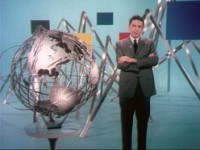
UNISPHERE: the largest representation of our globe ever attempted. UNISPHERE: the largest stainless steel structure yet built. Stainless steel. Why? Because it is to become a permanent landmark, UNISPHERE must be virtually maintenance-free yet remain enduringly beautiful. Stainless steel alone could do the job.
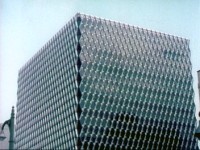
Decoratively used for years by architect and designer ...
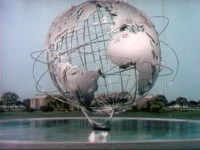
... it was easy to suggest stainless steel's strength and beauty for a structure so large.
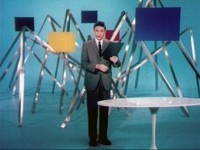
Here's what our engineers went to work on:
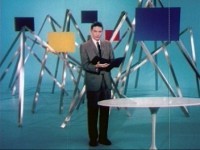
Assignment:
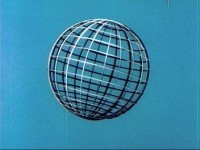
If UNISPHERE were to be harmonious when viewed from any angle ...
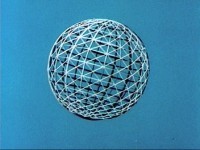
... no diagonal bracing could be used between parallels and meridians.
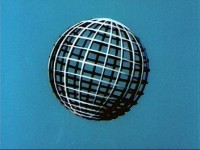
Take away such bracing and conventional structural members normally get heavier and bulky.
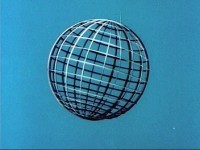
But each structural member of UNISPHERE must appear light and attractive.
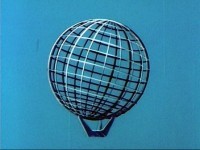
Perched atop a sculptured base, which must suggest lightness and grace ...

... UNISPHERE would have to withstand the enormous and changing forces of the wind as well as its own weight. The continents and islands would act like sails and wind pressure could exert forces nearly equal to the weight of the entire structure.
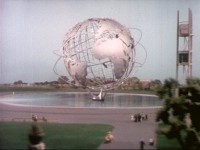
Because UNISPHERE is open and its land areas irregular in size and position, the wind blows on either the outside or the inside; the front of a continent or its back.

No past experience was available to calculate the wind forces because no one had ever built a UNISPHERE before or anything like it!
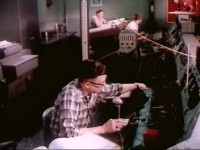
To meet this phase of the challenge, exhaustive wind tunnel tests were conducted at the University of Maryland.
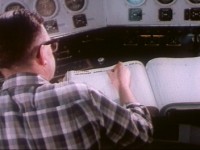
From these aerodynamic tests came the data that made design analysis possible.
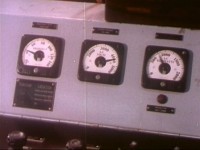
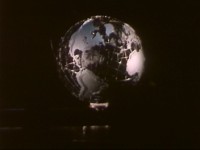
[wind tunnel model]
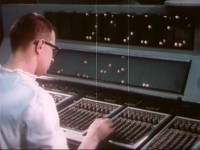
The mathematics of analysis posed its own peculiar challenge.
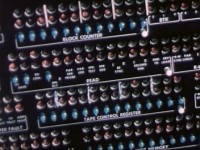
[UNISPHERE had to be completed by April, 1964. High-speed computers were used ...
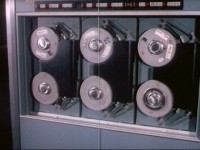
... to solve the thousands of problems that would have taken years if attempted manually.
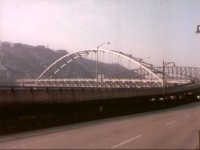
In the design of this bridge, for instance, it was necessary to solve only 35 simultaneous equations.

In UNISPHERE, one problem alone required a solution of 670 simultaneous equations.
