Article: The Many Images of the United States
THE MANY IMAGES OF THE UNITED STATES
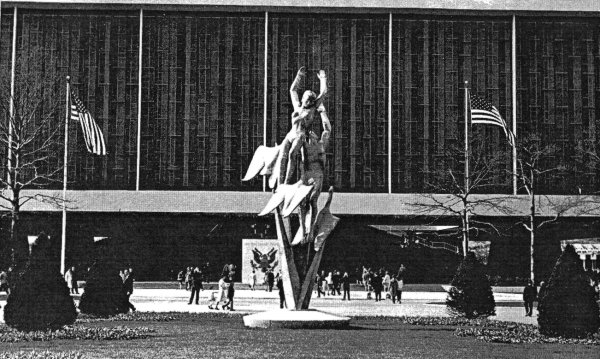
the big show is a Cinerama "ride" through 400 years of American History
FEATURE SHOW on the top floor of the huge United States Pavilion is a "ride" with film that takes the visitor through 400 years of the history of this nation.
The American Journey, produced by Cinerama, Inc., requires a dozen 55-seat vehicles which move along a 1,200-foot journey which passes 110 screens of every shape and size. 159 projectors (both movie and still) are used to fill the screens with scenes ranging from the depths of the sea to the outer reaches of space. Individual headsets built into each chair carry the narration ... "here is our past, look at it!"
An "Environmental" Film
The experience is called an "environmental" film program, designed to encourage audiences to feel "in" the events as they happen, to psychologically participatein the nation's history as it unfolds. The Journey begins with early scenes of America before the explorers arrived, rolls on though pictorial highlights on the past, leading up to the challenges of today's jet age.
There are 19-35mm motion picture, 14-16mm motion picture and 126 Eastman Carousel slide projectors along the ride. Narration for The American Journey was written by Ray Bradbury; Jeremy Lepard directed for Cinerama. The musical score is all "Americana" with sounds of railroad whistles, old tunes, harmonicas and the like.
Film "Voyage to America"
Before reaching the Cinerama show, visitors are first received in a 500-seat theater for a showing of Voyage to America. This introductory film was produced by Graphic Films Corporation in collaboration with John Houseman. Its black & white images utilize both live action and animation to move through America's Colonial period, to the phase of American Immigration and the period of Expansion (from 1820 to 1920.)
An original music score by Virgil Thomson, direction by Ben Jackson, and editing by Pieter Van Deusen of Graphic Films make this a notable film. It was narrated by Alexander Scourby and designed to create an understanding and mood of excitement and confidence in the American way of life -- past, present and future.
This nine-minute black & white film should be made available to the nation's schools when the Fair closes.
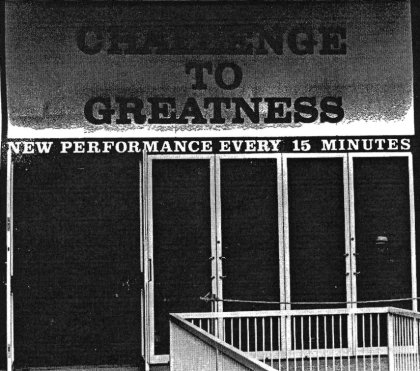
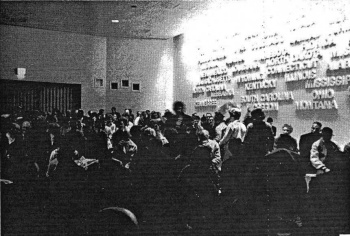
The Pavilion's theme "Challenge to Greatness" was endorsed by the late John F. Kennedy. It is exemplified in a Pavilion area of "Challenge" through which visitors walk on their way to the Journey film. Here several hundred other displays include continuous films shown at the bottom of a "well" set in the floor of the United States Pavilion.
Source: BUSINESS SCREEN MAGAZINE Presented courtesy Eric Paddon Collection