Miracle in the Meadow II
Building the Fair
Would the Fair be ready to open on time?
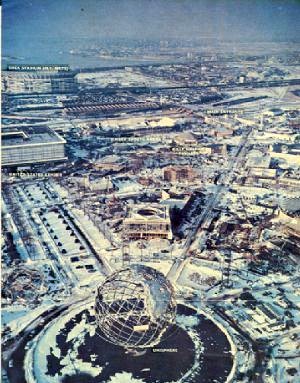
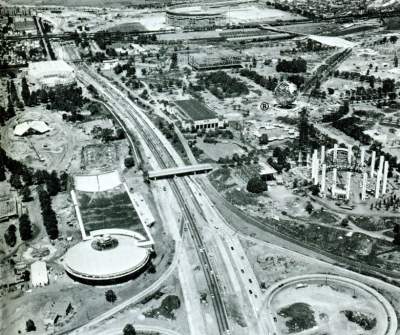
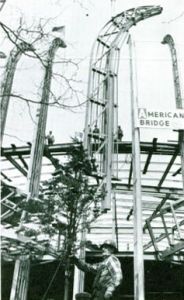
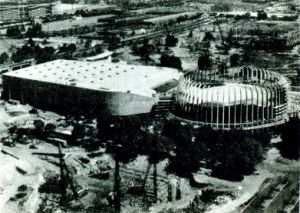
A recap of construction progress on Labor Day, 1963, showed pavilions in varying states of completion:
Austria -- structure being prefabricated in Austria.
Hall of Science -- driving piles.
Sinclair -- 30% completed, expected to be finished by October.
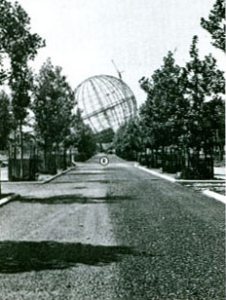
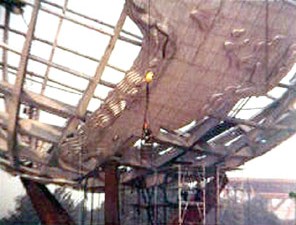
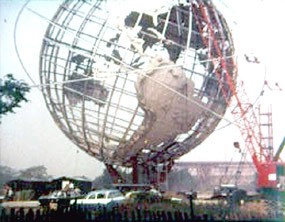
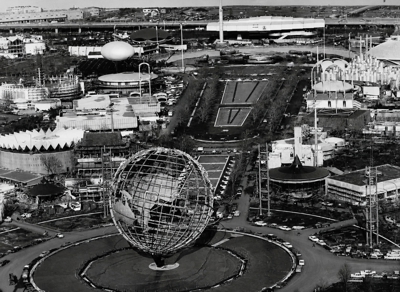
Unisphere -- all continents & orbital rings in place, completion expected in September.
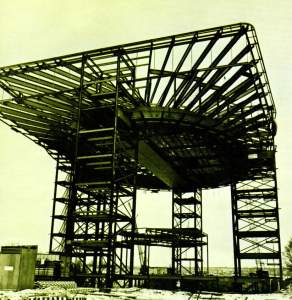
Federal Pavilion -- foundations complete, steel frame topped off August 22nd.
India -- Pile driving completed.
World of Food -- Piles completed, working on foundations, structural steel work to start September 2nd.
The utility system for the Fair involved 14 miles of water mains, 130 miles of high voltage electrical cables, 22 miles of storm and sanitary piping and 10 gas mains.
The huge scale model in the New York City Pavilion took over two years to build and cost $600,000.
No labor disagreements adversely affected progress toward the opening day goal.
Exhibitors and concessionaires put $550 million into construction and exhibits.
During July, 1963, 6,665 men worked at the Fair site and 2,332 worked on related arterial [highway] improvements.
The final steel beam was put in place on the Travelers' "umbrella" dome on May 16, 1963.
The Simmons Beautyrest Pavilion was the first pavilion completed in the Industrial Area.
5,000 tons of steel went into the construction of the Federal Pavilion. About 250,000 tons of steel went into the construction of various exhibit buildings.
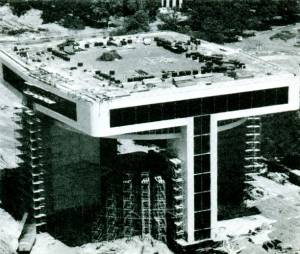
Before Formica could build its "House on the Hill," it had to build the hill; it used dirt excavated for other buildings that were constructed on the flat Fairgrounds.
The official "lighting up" of the General Electric Progressland dome, a display of multi-colored swirling lights, occurred on January 29, 1964. That date also marked the arrival of Disney's "Carousel of Progress" attraction at the pavilion.
By Labor Day, 1963, man-hours worked on the Fair totaled 12,936,660 with a payroll of $65,000,000.
Fair pavilions were constructed to withstand an Atlantic seaboard winter and exhibitors saved little in construction costs.
Of the thousands of trees growing in Flushing Meadow before the Fair, 200, ranging up to 50-feet tall, had to be transplanted because of construction.
No contractor hired a "night shift" for pavilion construction.
The Port Authority Heliport was completed and officially opened to the public on October 16, 1963.
The World's Fair Marina was made by the dredging of some two million cubic yards of silt from Flushing Bay.
Two years of planning, plus specially made cobblestones, went into the construction of Rheingold's "Little Old New York."
By the end of the summer of 1963, an additional 15,000 workers were thought needed in order to finish the Fair on time. Work was hastened in the last quarter of 1963 and the additional manpower was not needed.
The Gas Companies Pavilion was the first to start building. Groundbreaking was in April, 1962, twenty-four months before opening day.
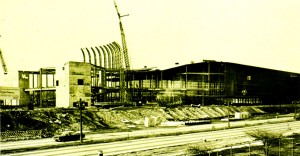
The largest pavilions constructed for the Fair were General Motors' and Ford's with 320,000 and 227,360 sq. feet of floor area.
More than 3,500 bench units were placed in street malls and park areas throughout the Fairgrounds as construction neared an end.
Besides Simmons, eleven other pavilions were complete inside and out by January, 1964 - Century Grill, Dynamic Maturity, Eastman Kodak, First National City Bank, Formica, the Heliport, Hall of Free Enterprise, International Plaza, the Post Office, Sinclair and Mobil.
The Fountains of the Planets, installed in the Pool of Industry, were completed by December 7, 1963 when they were activated in a preview show to test the water patterns, color, sound and fireworks displays.
Most pavilion foundations and roofs had an estimated "natural life" of five years.
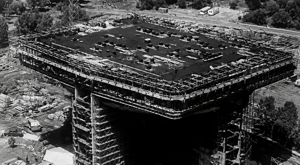
Port Authority Heliport
SOURCE:
Screen Shot - NY World's Fair Publicity Film
SOURCE: FAIR NEWS
February 19, 1963
SOURCE: NY World's Fair Progress Report No. 8
April 22, 1963
SOURCE: NY World's Fair Progress Report No. 9
September 26, 1963
SOURCE: NY World's Fair Progress Report No. 9
September 26, 1963
Ford Motor Company
SOURCE: NY World's Fair Progress Report No. 8
April 22, 1963
SOURCE: FAIR NEWS
April 16, 1963
SOURCE: NY World's Fair Progress Report No. 9
September 26, 1963
SOURCE: FAIR NEWS
July 22, 1963
SOURCE: Bell System Promotional Film "A Ballad for the Fair"
Presented Courtesy Mitch Dakelman and Ray Dashner Collection (unless otherwise noted)
SOURCE: Online auction
SOURCE: Online auction
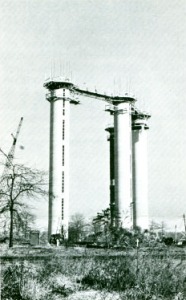
New York State Pavilion
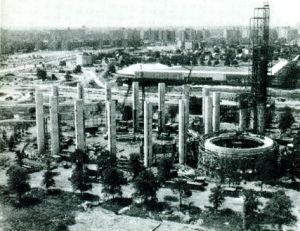
SOURCE: NY World's Fair Progress Report No. 9
September 26, 1963
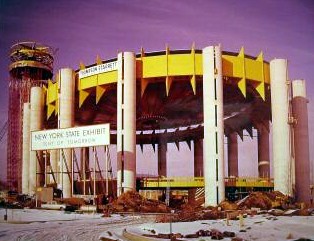
SOURCE: online auction
Federal Pavilion
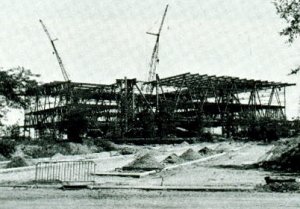
SOURCE: NY World's Fair Progress Report No. 9
September 26, 1963
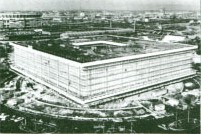
SOURCE: FAIR NEWS
January 22, 1964
Gas Companies
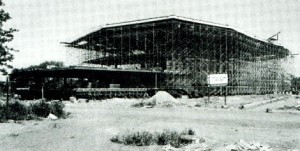
SOURCE: NY World's Fair Progress Report No. 9
September 26, 1963
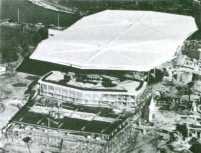
SOURCE: FAIR NEWS
January 22, 1964
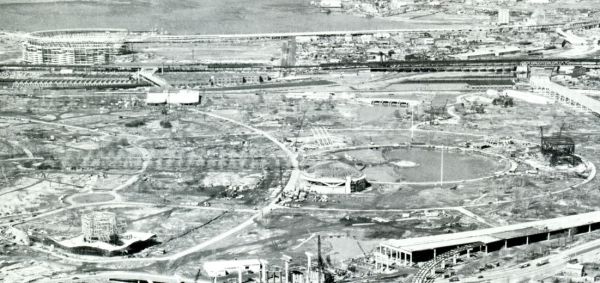
SOURCE: NY World's Fair Progress Report No. 8
April 22, 1963
House of Good Taste - AMF Monorail
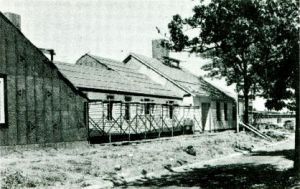
SOURCE: NY World's Fair Progress Report No. 9
September 26, 1963
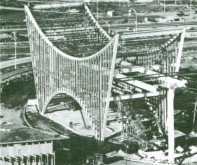
SOURCE: FAIR NEWS
January 22, 1964
Austria - Vatican - Tower of Light
- Astral Fountain
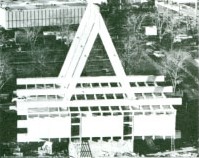
SOURCE: FAIR NEWS
January 22, 1964
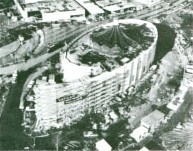
SOURCE: FAIR NEWS
January 22, 1964
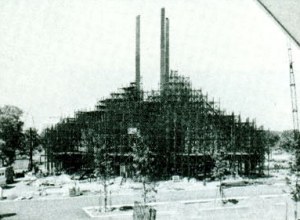
SOURCE: NY World's Fair Progress Report No. 9
September 26, 1963
SOURCE: NY World's Fair Progress Report No. 9
September 26, 1963
SOURCE: FAIR NEWS
March 22, 1964
American Interiors - Mormon Church - Malaya
Johnson Wax
SOURCE: NY World's Fair Progress Report No. 9
September 26, 1963
SOURCE: FAIR NEWS
January 22, 1964
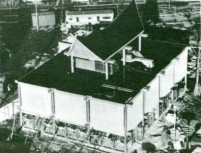
SOURCE: FAIR NEWS
January 22, 1964
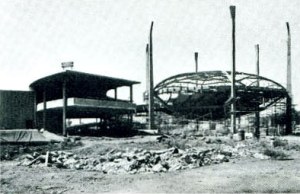
SOURCE: NY World's Fair Progress Report No. 9
September 26, 1963
Rheingold - Pakistan
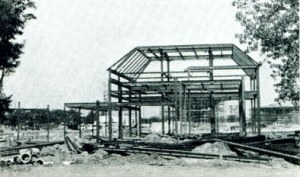
SOURCE: NY World's Fair Progress Report No. 9
September 26, 1963
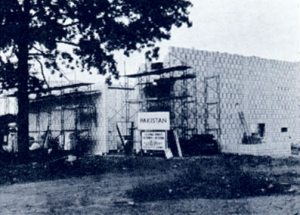
SOURCE: NY World's Fair Progress Report No. 9
September 26, 1963
Builders of the Fair
LABOR
An army of almost 9,000 building and construction tradesmen are racing against time to assure that the Fair and the approaches will open on April 22, 1964. They play the final part in the long task of creating reality from an idea. The finished product, clean and polished, is labor's contribution to a great Fair. Unnoticed, but of equal importance, is the work on buried utilities and foundations, the hidden structural frames and mechanical equipment that make an exhibit possible.
More than 200 exhibits, buildings and other structures are under way at the Fair. It is an outstanding tribute to the building trades unions that no labor disagreement has adversely affected progress toward the opening day goal. The pledge of labor peace has been kept. By June 30, 1963, when collective bargaining agreements of fifteen of the construction trades were due to expire, most contracts had been successfully renegotiated. The other trades continued work without interruption until contracts were signed.
Early in the fair history, the Building and Construction Industry, both management and labor, established machinery to which all disputes, actual or potential, could be referred. Peter J. Brennan, president of the Building and Construction Trades Council; Peter W. Eller and Walter M. Colleran, chairman and secretary respectively, of the Building and Construction Industry Advisory Committee, and leaders from each union have cooperated to make it function effectively.
During July 1963, 6,665 men worked at the Fair site and 2,332 worked on related arterial improvements -- a total of 8,997. Since the start of the Fair complex and as of July 31, 1963, man hours of work totaled 12,936,660 with a total payroll of over $65,000,000.
With a little over six months to go, there is every indication that labor relations, with one of the greatest armies of workers ever assembled in a square mile site, will continue to be excellent and that labor's previous record of outstanding performance will be more than equaled.
More than 30,000 will be employed by the exhibitors and concessionaires at the Fair in maintenance, service and entertainment. The same care and forethought is being given to the problems of this even greater army. Means are being set up for ready adjustments of disputes. Results will, no doubt, come up to the record made during the construction period.
SOURCE: NY World's Fair Progress Report No. 9 September 26, 1963